Developer update
Wodby CLI 2.6.0 adds expanded Wodby operations
Wodby CLI now does more than CI build, push, and deploy workflows. Starting with version 2.6.0, the CLI includes expanded operational commands for Wodby resources, streamed task logs for build and deployment work, and a generated reference for the full command surface.
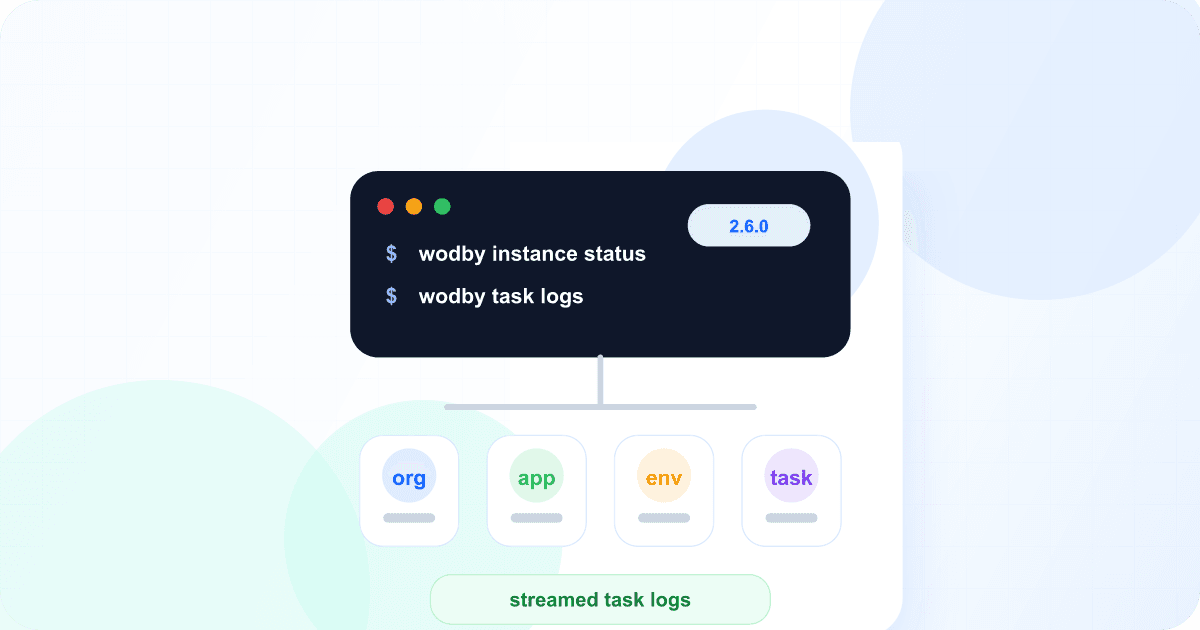
The CLI is still the same tool teams use from GitHub Actions, GitLab CI, CircleCI, Wodby CI, and other pipelines. The new operational commands make it useful outside pipeline runs too: list and inspect resources, create or update supported objects, trigger actions, stream task logs, and wait for asynchronous work from a terminal.
This gives teams a lightweight option between clicking through the dashboard and writing direct REST API integrations. Use the CLI when you want a scriptable command; use the API or SDKs when you need application-level integration code.
What is new in 2.6.0
- Broader commands for Wodby resources, including users, organizations, members, projects, environments, integrations, providers, stacks, services, apps, app environments, clusters, databases, builds, deployments, backups, imports, and tasks.
- New and expanded workflows for app and app-environment creation, app and app-environment status, name lookups, app ports, certificates, stack services, service child resources, build and deployment workflows, databases, and database users.
- Streamed task logs for build and deployment task flows, plus improved task log delivery and display.
- Table output for quick terminal use, JSON output for scripts, and richer read views for command output.
- JSON request body input for create and update commands where the object needs more detail than simple flags.
- A generated CLI reference at wodby.com/docs/2.0/cli.
Command groups now cover day-to-day operations
| Area | Examples |
|---|---|
| Users, organizations, and projects | wodby user getwodby org currentwodby member listwodby project create |
| Apps, app environments, and status | wodby app createwodby app get-by-namewodby instance createwodby instance status |
| Infrastructure, integrations, and data | wodby cluster listwodby integration listwodby database createwodby database user list |
| Services, routes, ports, and certs | wodby aps actionwodby route listwodby port listwodby cert list |
| Builds, deployments, and tasks | wodby build deploywodby deployment waitwodby task logswodby task repeat |
Create apps and app environments from the CLI
The reference now includes wodby app create for new apps and wodby instance create for new app environments. Both commands accept direct flags for common fields, plus --data or --file when you want to send a complete JSON request body.
Use the app command when the app does not exist yet and you want to define its initial app environment in the same request. Use theinstance command when the app already exists and you are adding another environment or cluster target.
wodby app create \
  --name my-app \
  --title "My app" \
  --project PROJECT_ID \
  --stack STACK_ID_OR_NAME \
  --env dev \
  --cluster CLUSTER_ID_OR_NAME \
  --instance dev \
  --instance-title "Development" \
  --domain dev.example.com \
  --wait

wodby instance create \
  --app my-app \
  --instance staging \
  --instance-title "Staging" \
  --env staging \
  --cluster CLUSTER_ID_OR_NAME \
  --domain staging.example.com \
  --wait
Designed for both humans and scripts
Most operational command groups support -o table for readable terminal output and -o json for automation. That makes the same command useful in a local shell, a CI job, or a small maintenance script.
export WODBY_API_KEY=...

wodby app status 12345 -o table
wodby database list -o json
wodby build deploy 67890 --wait
wodby task logs 24680 --all-jobs
CI commands are still there
Nothing changes for existing pipelines. wodby ci init, wodby ci build, wodby ci push, wodby ci deploy, and wodby ci run remain the stack-aware build and deployment path for external CI systems and Wodby CI.
Install 2.6.0 or newer
Install the latest Wodby CLI release from GitHub releases, then authenticate with WODBY_API_KEY. Version 2.6.0 is the baseline for the expanded operational command and log streaming work described in this post.
Read the new reference
The new Wodby CLI reference is generated from the CLI command tree, so it now lists the top-level commands, subcommands, usage strings, options, inherited flags, and shell completion commands in one place.