Infrastructure setup that fits your team
Use hosted clusters, managed Kubernetes, or self-hosted Kubernetes while keeping the same application delivery workflow.
DevOps as a Service
Wodby gives your team the delivery platform behind modern DevOps: Kubernetes options, reusable stacks, CI/CD, environments, scaling, backups, integrations, access control, and runtime visibility without forcing every team to assemble the platform layer itself.
What Wodby handles
Instead of assembling clusters, deployment scripts, environment rules, backup jobs, and access policies one piece at a time, use a platform workflow that keeps them connected to the apps your team ships.
Outcome
A smaller platform burden, more repeatable releases, and a clearer path from code to production.
Use hosted clusters, managed Kubernetes, or self-hosted Kubernetes while keeping the same application delivery workflow.
Standardize runtimes, databases, caches, proxies, and settings in stack definitions teams can reuse.
Use Wodby CI for the fastest path or connect existing pipelines with Wodby CLI, deployment history, and automatic rollback attempts.
Keep Git-backed services, stack revisions, app environments, and infrastructure current through controlled update policies.
Handle scaling, routing, backups, SSL, access control, integrations, logs, and environment management from one place.
Use the public REST API, SDKs, CLI, and MCP server for internal tooling, scripts, CI jobs, and assistant-driven operations.
How it works
Wodby keeps infrastructure, stack definition, and deployment automation in the same product workflow so teams do not have to manage those handoffs manually.
Pick the infrastructure model that matches your team, then run clusters, apps, and core operations from one managed Wodby workflow.
Capture app services, databases, settings, links, and integrations in stack definitions that can be reused across projects and environments.
Connect source repositories, build images, deploy changes, and keep releases aligned with the stack your team is actually running, including deployment history and rollback-aware controls.
Operational control
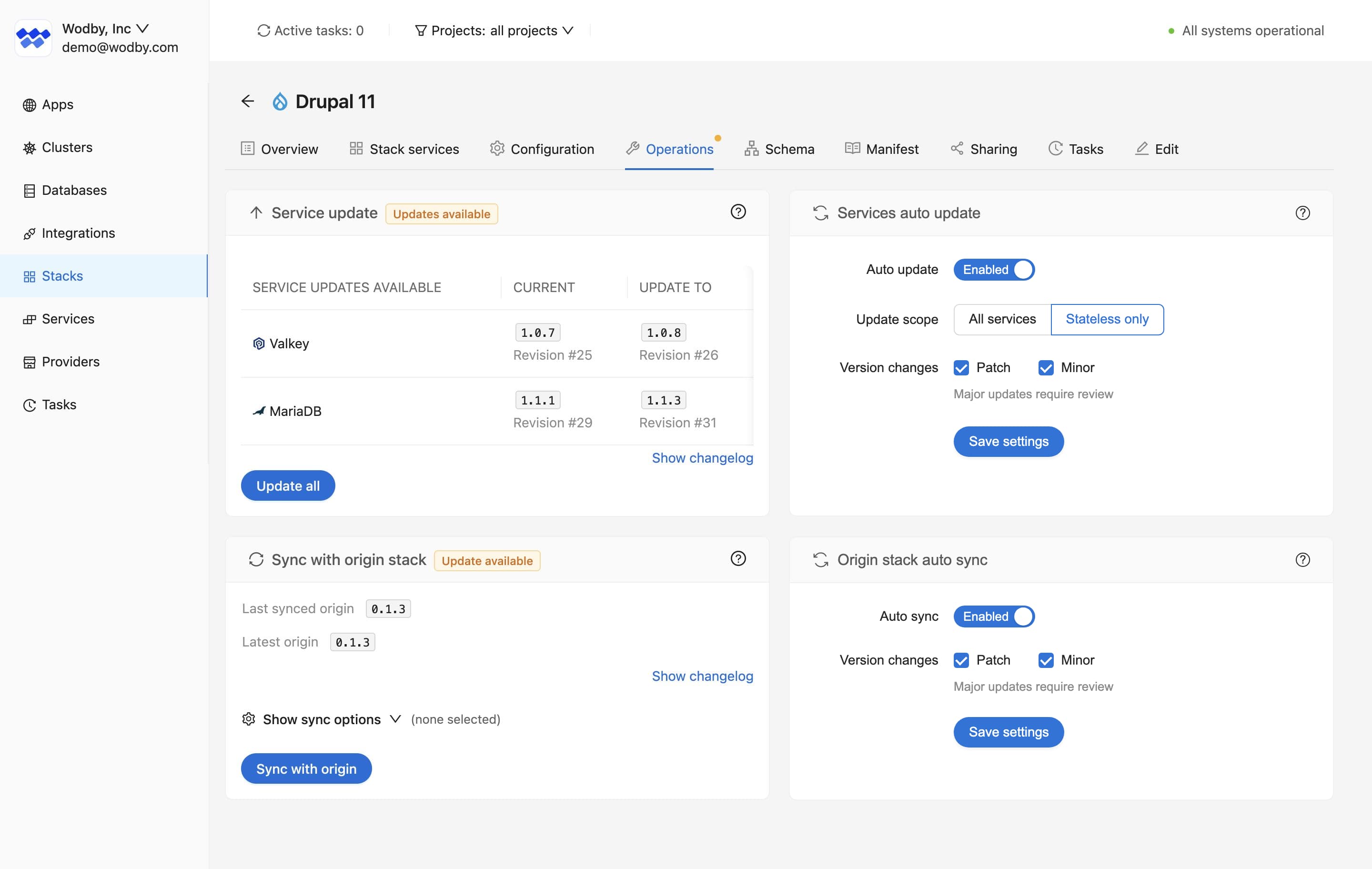
Wodby maintains reusable services and stacks. Review available service updates, choose automatic update policies, and sync copied stacks with their origin. New stack revisions reach running environments according to each environment's rollout policy.
Version stack changes instead of scattering infrastructure edits.
Keep stack services, copied origins, app environments, and infrastructure current with controlled automatic updates.
Manage app service settings, resources, links, volumes, actions, and terminal access without raw Kubernetes plumbing.
Scale app services and cluster capacity as workloads change.
Attach provider integrations without hardcoding credentials.
Use routing, backups, imports, SSL, cron, and logs inside the same workflow.
Infrastructure choices
The platform workflow stays consistent across infrastructure models, whether your team wants Wodby to handle more of the cluster layer or prefers to keep infrastructure in its own account or servers.
Use hosted persistent clusters when you want Wodby to manage more of the infrastructure layer for you.
Explore option
Keep infrastructure in your cloud account while Wodby manages the application delivery workflow on top of Kubernetes.
Explore option
Run a budget single-server Kubernetes setup for internal tools, smaller app portfolios, and workloads that do not need cluster scaling.
Explore option
Best fit
Wodby works best when the main problem is not writing code, but keeping the delivery and operations foundation consistent as applications, environments, and teams grow.
Product teams that need production-ready delivery without hiring a full platform team first.
Agencies and service teams managing multiple client applications from one operational model.
Organizations moving from single-server hosting or legacy PaaS workflows toward Kubernetes.
Teams that want better DevOps consistency while keeping cloud and tooling choices flexible.
Reliable and repeatable
Reducing DevOps work should not mean handing production operations to generated scripts or improvised YAML. Wodby gives teams repeatable best-practice workflows that are maintained as part of the platform.
Start from maintained stack patterns for Kubernetes, CI/CD, services, routing, backups, SSL, and environment management instead of inventing every baseline yourself.
Keep stack revisions, service updates, releases, and environment changes inside a product workflow your team can repeat across applications.
Avoid trusting ad hoc scripts, generated YAML, or unmaintained automation for production operations. Wodby gives you a maintained platform workflow with visible building blocks.
Open platform
Run Kubernetes in your own cloud account or on your dedicated server and retain infrastructure ownership. Wodby provides deployment, maintenance, and resource management tools, backed by public images, Helm charts, and stack definitions you can inspect.
Keep your cluster in your cloud account or use a server you control. Wodby provides the operational tools on top; Wodby Cloud is the separate option for Wodby-hosted infrastructure.
Wodby services and stacks use public Helm charts and Docker images, with stack definitions and related building blocks published in Wodby GitHub repositories.
The public service, stack, image, and chart assets are maintained by Wodby so teams can inspect what runs while still using a managed platform workflow.
Support model
Wodby is a managed platform first. Paid plans include basic best-effort DevOps support, while premium support is available when your operational load needs a higher-touch service.
Paid Wodby plans include basic best-effort DevOps support for platform usage, configuration questions, and normal troubleshooting.
For teams running many applications or requiring a lot of ongoing operational maintenance, Wodby offers a premium support service.
Platform scope
Wodby keeps the important operational pieces visible to your team: what stack is deployed, which services run, where builds come from, how environments differ, and what needs attention.
Build internal tools and scripts with REST API, SDKs, CLI commands, and MCP access.
Use managed database options, backups, imports, and environment sync patterns.
Use stack-aware CI/CD with deployment history, selected-service deploys, and rollback attempts.
Keep services, stacks, app environments, and infrastructure current through visible update tasks.
FAQ
Use these answers to decide whether Wodby should be the platform layer for your application delivery workflow.
Wodby gives teams a managed platform workflow for application delivery: Kubernetes infrastructure options, reusable stacks, CI/CD, automatic updates, app environments, routing, backups, integrations, access control, developer automation, and operational visibility.
Wodby reduces platform setup and maintenance work, especially when you choose Wodby Cloud so Wodby also manages the cluster layer, but production ownership still stays with your team. Paid plans include basic best-effort DevOps support for normal platform questions. For operations that require a lot of ongoing maintenance or many applications, Wodby offers premium support.
Yes. You can connect managed Kubernetes in your own account or use self-hosted Kubernetes on one dedicated server for budget hosting. The right setup depends on whether you need Kubernetes scaling or a lower-cost single-server environment.
Yes. Teams can use Wodby CI or keep existing CI systems and deploy with the Wodby CLI while staying connected to the same stack and environment model.
No. Wodby builds on standard Kubernetes and open-source components instead of proprietary orchestration. Wodby services and stacks use public Helm charts and Docker images, with related stack definitions and platform building blocks published in Wodby GitHub repositories and maintained by Wodby.
Wodby paid plans include basic best-effort DevOps support for platform usage, configuration questions, and normal troubleshooting. Premium support is available when your operations require deeper hands-on maintenance, many applications, or a higher-touch support relationship.
Start with the platform, not another DevOps backlog
Use hosted clusters, connect your Kubernetes provider, or run self-hosted Kubernetes. The app delivery workflow stays consistent as your infrastructure choices change.