Catalog update
14 new framework stacks: Java, .NET, Rust, Symfony, and JavaScript
Fourteen new stacks for building your own applications: Java, .NET, Rust, Symfony, and the popular JavaScript frameworks. Each one comes with a boilerplate, so a new app starts from working code in your own repository.
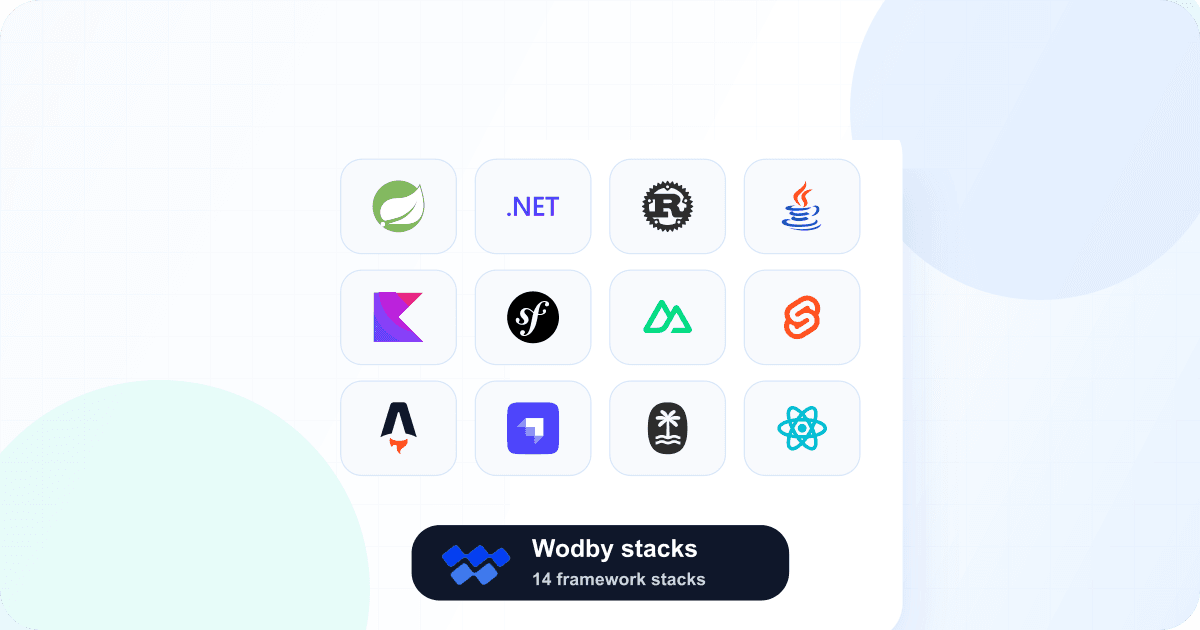
Every application on Wodby starts from a stack: a reusable set of services, links, and configuration that your app environments share. These stacks add languages and frameworks that Wodby did not cover before, with a database, cache, email, and document rendering already connected and switched on only when you need them.
Framework stacks with boilerplates
Each of these stacks comes with a public boilerplate. When you create an app, Wodby can copy the boilerplate into a new GitHub or GitLab repository, so you start with working code that already builds and deploys on Wodby. If you already have a project, connect its repository instead.
Java web apps and APIs with Spring Boot. PostgreSQL is enabled and connected to the app. Valkey, email, and document rendering are included and switched off until you need them.
Boilerplate: wodby/spring-boot-boilerplate
.NET web apps and APIs. PostgreSQL, Valkey, email, and document rendering are already connected and switched off, so a new app starts small.
Boilerplate: wodby/aspnetcore-boilerplate
PHP apps on Symfony, served by PHP-FPM behind Nginx. PostgreSQL and Mailpit are enabled; switch to OpenSMTPD for real email delivery.
Boilerplate: wodby/symfony-boilerplate
Full-stack React apps with TanStack Start on Node.js. Add PostgreSQL, Valkey, or email when the app needs them.
Boilerplate: wodby/tanstack-start-boilerplate
Vue apps with Nuxt on Node.js. PostgreSQL, Valkey, email, and document rendering are included and switched off until you need them.
Boilerplate: wodby/nuxt-boilerplate
Svelte apps with SvelteKit on Node.js, with the same optional PostgreSQL, Valkey, email, and document rendering.
Boilerplate: wodby/sveltekit-boilerplate
Content sites and server-rendered apps with Astro on Node.js, with the same optional services.
Boilerplate: wodby/astro-boilerplate
A headless CMS on Node.js. PostgreSQL and persistent upload storage are enabled; email is optional.
Boilerplate: wodby/strapi-boilerplate
Java, Kotlin, and Rust runtimes
Not every project uses a framework we ship a stack for. These runtime stacks run any app written in the language, with the same optional PostgreSQL, Valkey, email, and document rendering services already connected. They join the existing Node.js, PHP, Python, Ruby, and Go stacks.
React, Vue, and Angular frontends
Wodby builds the app from your repository and serves the compiled site with Nginx.
Ready for dev workspaces
All fourteen stacks work with dev workspaces, so you or an AI agent can change code against a running copy of the app before you release it.
All of them except the three frontend stacks also include an optional OpenTelemetry Collector. Turn it on, and the app gets the standard OpenTelemetry variables, so its traces, metrics, and logs can go to the observability backend of your choice.
Available now
All 14 stacks are public. Browse the stack catalog to see what each one contains, then open Stacks in the Wodby dashboard and use Add stack to copy the one you want into your organization or project.
The copy is yours to change: add services, edit configuration, and publish your own revisions. It stays linked to the catalog version, so you can pull in later catalog updates or keep it as it is. The stacks documentation covers how revisions, links, and updates work.
Each stack has a guide in the stack catalog documentation that walks through creating the environment, connecting its services, and backups. The dashboard links a stack's guide from the stack itself, including your copy. You can also ask Wodby Agent to recommend a stack for your idea and create the app for you.